
CDE platform for residential developers – from zoning approval to post-handover defects

A CDE platform for a residential developer becomes necessary long before the first spade hits the ground. The documentation of a housing project starts earlier than construction itself: zoning conditions, the architectural design with its successive revisions, reviews from discipline consultants, notifications to the authorities, the building permit, and tender documentation for the general contractor. Each of these stages generates documents, involves different people and requires decisions that have consequences for the stages that follow.
Most development companies manage all this with emails, folders on shared drives and Excel spreadsheets. It works – up to a certain scale. With several projects running in parallel and dozens of people involved in each, the cost of information chaos stops being abstract.
A CDE (Common Data Environment) is a single, controlled place where all project documentation – design, administrative, construction and as-built – is stored, versioned and shared with participants according to their permissions.
The scale of the problem a CDE solves is measurable. The Autodesk and FMI study “Harnessing the Data Advantage in Construction” (more than 3,900 respondents, 2020 data) estimates that “bad data” – inaccurate, incomplete, inaccessible or out of date – may have cost the global construction industry USD 1.85 trillion; 30% of respondents admitted that more than half of their project data is “bad” in this way. The earlier FMI and PlanGrid report “Construction Disconnected” (2018) calculates that construction workers spend 35% of their time – more than 14 hours a week – on non-productive activities, including 5.5 hours just looking for project information, and that 48% of rework on US construction sites stems from bad data and poor communication. A fair caveat: both studies were commissioned by software vendors and focus mainly on contractors rather than developers. Still, the order of magnitude is hard to ignore.
Sources: Autodesk & FMI, Harnessing the Data Advantage in Construction · FMI & PlanGrid, Construction Disconnected (2018)

Source: Hustro
1. Where information gets lost – and what it costs
1.85 trillion
USD – estimated cost of “bad data” in construction
5.5 h
a week spent searching for project information
48%
of rework stems from bad data and poor communication
1.1 Design stage – many reviews, no single place
The architect, the structural consultant, the MEP consultant and the project coordinator watching the net usable area and financial parameters all review the same design – but each of them looks at different things and communicates through a separate channel. The architect receives comments in four emails sent on different days, some of them contradictory and with no clear priority. The decision on which comments take precedence is made in a meeting. The minutes of that meeting end up in someone’s inbox – if anyone wrote them and sent them to everyone who needed them.
Two months later the general contractor asks why the wall between flats 3A and 3B is thicker than standard. The answer is somewhere in the correspondence from that period.
1.2 Administrative procedures – deadlines that must be tracked
Zoning conditions have a validity period. So does the building permit. These are hard deadlines with legal and financial consequences – missing them can block the project or force it to go through the procedure again.
A CDE will not replace a system for managing administrative deadlines, nor will it speed up the authorities. But it can be the place where administrative documentation – applications, decisions, correspondence with the authorities, successive versions of attachments – is stored together with the design documentation, rather than in a separate folder on the drive of whoever handled a given application. When that person leaves the company or moves to another project, the administrative history of the development does not leave with them.
1.3 Tender documentation for the general contractor
The design handed over to the general contractor for pricing should be complete and consistent. If it is not, the contractor asks questions – and every question costs time on both sides. Some of these questions stem from ambiguities that could have been resolved earlier if the history of design decisions had been accessible and clear.
Design errors are the most expensive category of errors. The UK Get It Right Initiative, which is independent of software vendors, estimates on the basis of 2015–2016 research that the direct cost of avoidable errors is around 5% of project value – and around 21% once indirect costs, unrecorded process losses and latent defects are included. Five of the ten main causes of error identified by GIRI relate to the design stage. That is an argument for the CDE to start with the design, not when the general contractor arrives on site.
Sources: Get It Right Initiative · GIRI, Investing in Design
2. The developer’s decision-making committee at the design stage
On a residential project, the developer manages several parallel streams of feedback:
- Architect. Iterations of the vision for the estate and the building, the functional layout, the finish standard of common areas. On a larger project, a dozen or more rounds of comments and changes.
- Structural consultant. Verifying the feasibility and economics of the architectural solutions. Their comments concern different drawings than the architect’s, but changes resulting from their review affect what the architect has to rework.
- MEP consultant. Coordinating building services with the architecture and structure. A clash between services and structure discovered on site costs many times more than one caught in the design.
- Project coordinator. Verifying financial parameters: net usable area, the fit-out budget, the layout of units in terms of the sales offer. Questions that have to be asked and answered before the design goes out to tender.
- Sales department. Unit data sheets, finish standards, buyer-requested changes – one of the biggest generators of changes in residential documentation, often left out of descriptions of the design workflow. Every buyer change is a drawing change that has to reach the structural engineer, the MEP designer and the general contractor.
- Financing bank. Releasing tranches from the escrow account requires progress documentation that the bank’s inspector can verify without digging through folders. The bank does not review the design, but it receives its documentation throughout the entire project.
Each of these people needs the current version of the documentation. Each generates comments that should be available to the others. Without a system, these streams run separately and converge in meetings – or not at all.
3. What a CDE platform changes for a residential developer
3.1 One review workflow instead of parallel emails
The architect uploads a revision. All reviewers see the same version and enter their comments directly on the document. The developer sees in one place who has responded and who has not, and where there are conflicting comments that need a decision. When the architect uploads the next revision incorporating the changes, the old version goes to the archive.
The question “which drawing is current?” no longer needs a human to answer it.
A condition that is easy to forget: this workflow only works if the obligation to use the CDE, file formats, deadlines for responding to comments and the status of records in the system are written into the contracts with the designer and the general contractor. Without that, the CDE is a goodwill tool rather than a process – and in a dispute, a record in the system carries only as much weight as the contract gives it.

Source: Hustro
3.2 Decision history available throughout the project
Every design decision – a change to a wall layout, a choice of material, a modification to the services – is recorded against the document it concerns, with the date and author. When the general contractor asks about a solution during pricing, when the site supervisor asks about it during construction, when a buyer files a complaint after handover – the answer is in the system.
3.3 Administrative documentation alongside the design
Zoning applications, decisions, correspondence with the authorities, successive versions of attachments – stored in the same system as the design documentation, with the same access permissions and the same version history. The CDE does not automatically track the validity of administrative decisions, but their history and the completeness of the documentation are available without searching through folders.
3.4 Preparing tender documentation for the general contractor
The developer knows which documents have been approved by all reviewers and which are still in circulation. The general contractor gets access with permissions limited to the pricing stage, asks questions through the system, and the answers are recorded against the documents they concern.
4. System continuity from design through construction
When the general contractor arrives on site, the CDE platform is already configured and holds the project history. The contractor gets access with contractor permissions and uploads the construction documentation into an environment the developer already knows and uses.
This is an important difference compared with a model in which the CDE only appears when the general contractor comes on board. A developer who starts at the design stage has continuity – one system, one history, one point of reference for all participants throughout the project.
4.1 What the developer controls on site
- Material submittals. Submitted by the subcontractor, reviewed by the discipline inspector, approved by the developer – with a comment history and a link to the construction drawing they concern. When the material on site differs from the approved submittal, there is evidence.
- Formal correspondence with the general contractor. Letters, change orders, meeting minutes. In a dispute over the scope of works or a change in standard, the correspondence history in the system is evidence.
- Reports from the site. The site supervisor reports a non-conformity via the mobile app, describes the location and takes a photo. The report goes into the system with a date and status. The general contractor has a deadline to respond.
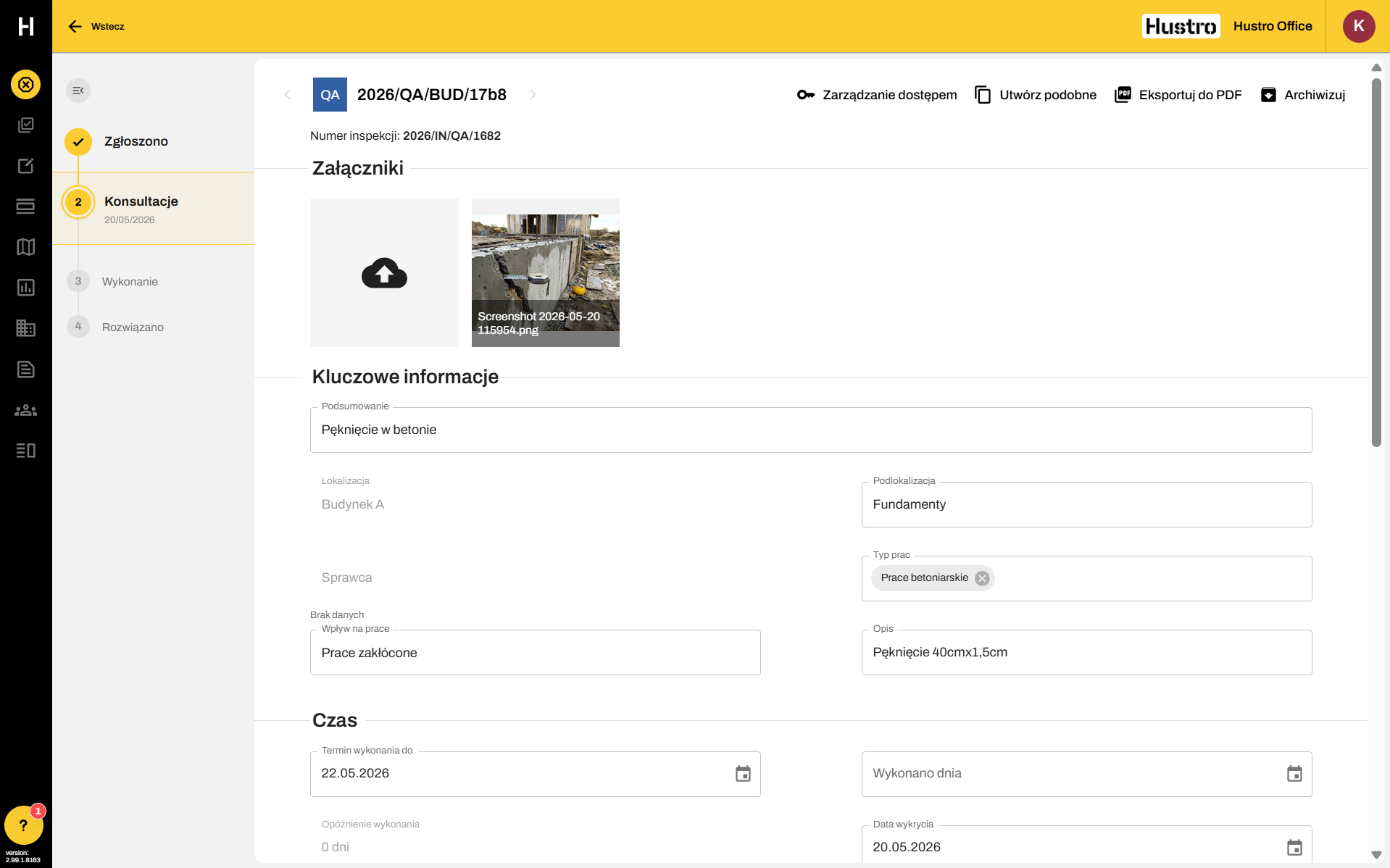
Source: Hustro
5. Warranty and defects – where most developers lose control
On an estate of two hundred flats, the number of warranty claims in the first two years after handover runs into the hundreds. Each has to be assigned to a contractor, given a deadline and confirmed as completed. Without a system, one person does this from an Excel sheet.
The scale is bigger than it seems. Based on 1,690 technical handover inspections in the Wielkopolska region, the inspection company Inspekcja Domu reports an average of 17.43 defects per property inspected; the most common category is uneven walls and lack of right angles (56.5% of inspections). The sample is not random – it covers units whose buyers commissioned the inspection themselves – but for 200 units it gives an order of magnitude of 3,000 items in handover reports before warranty claims even begin. It is also worth remembering that two different clocks are running: towards the buyer, the developer is liable under statutory warranty for five years from handover, while recourse against contractors follows the terms and deadlines of the construction contract. Without a documented history – who, when, what scope, based on which drawing – the developer is left with a repair cost it cannot pass on to anyone.
Defect data source: Inspekcja Domu, Most common defects in flats and houses from developers
17.43
defects on average per handover
~3,000
report items for 200 units
5 years
of statutory warranty towards the buyer from handover
In a CDE used throughout the project, a warranty claim goes to the same place as a report from the construction site. It is assigned to the contractor responsible for that scope, has a deadline and a status. The technical documentation of the installation affected by the defect is available in the same system – and so is the history of design decisions that led to that solution.
6. Scaling – from one project to a portfolio
The first project in the system takes work: setting up the environment, the folder structure, approval workflows, training. A few weeks.
The second project starts from the template developed on the first. Configuration takes days. The architect, consultants and general contractor get access to an environment that works exactly as it did on the previous project.
By the third and fourth projects, the CDE is no longer an implementation project – it becomes the company’s operating standard. A new project manager joining a project halfway through has access to its full history. The board sees the status of all active projects without weekly reports compiled by hand.
From the board’s perspective, there are three concrete effects: one reporting standard for all projects instead of a separate format for each; less dependence on specific people when project managers rotate; and easier due diligence when selling a project, refinancing or bringing in an equity partner – because the documentation and decision history are in one place, not in the inboxes of people who no longer work for the company.
7. Documentation after project completion
The as-built documentation goes to the homeowners’ association. Servicing of building installations requires access to the technical documentation of specific equipment. Buyers are entitled to the documentation relating to their own flat.
Worth checking before signing a contract with a vendor: what format the data export is in, whether it preserves the folder structure and metadata, whether you can run it yourself without involving the vendor, and what happens to archive access once the project is closed.
A fuller list of questions you can hand to a project manager or lawyer as a script for talking to vendors:
7.1 Data ownership and exiting the system
Can a full export of the documentation – files, folder structure, metadata, version history, comments – be done independently, without the vendor’s involvement, and in what format? What happens to the data when the contract expires: how long does it remain available, and who bears the cost of archiving a closed project? Does the contract state explicitly that the data belongs to the developer?
7.2 Third-party access
Do the architect, consultants and general contractor get access without their own licence, and does the cost grow with the number of external users? How finely can permissions be restricted – by stage (the contractor only sees tender documentation) and by scope (a subcontractor only sees their own discipline)? Can a unit buyer or the homeowners’ association be given access only to the documentation within their scope?
7.3 Evidential value of records
Does every change, comment and decision carry an immutable timestamp and author, and can that audit trail be exported for a dispute? What happens to previous versions of a document when a new one is uploaded, and can you see who marked a version as current? Does the vendor hold a security certification (e.g. ISO 27001), and where is the data physically stored – which matters for GDPR and buyers’ personal data?
7.4 Continuity between stages
Can the same environment handle the design stage, construction and the warranty period, or does data have to be moved between modules or systems? Can the configuration of the first project – structure, approval workflows, templates – be copied to the next ones?
7.5 Total cost
What is the cost of implementation and training, what is the subscription cost, and what does the price depend on: the number of projects, users or storage? Are there hidden costs: export, archive, additional modules, integrations?
8. Summary
A CDE platform for a residential developer brings design, administrative, construction and as-built documentation together in one environment – from zoning conditions to defects reported after handover. As a result, the decision-making committee, the site manager and the after-sales team work on the same, up-to-date data instead of searching for it in emails and separate systems. Warranty management, scaling to further projects and handing documentation over to the homeowners’ association stop being separate implementation projects, because they use the same data structure as the design stage. The developer gains continuity of information throughout the entire project life cycle – and spends less time reconstructing the history of decisions.
CDE platform for residential developers – see how it works
One environment for design, administrative, construction and as-built documentation – from zoning conditions to defects in the warranty period.
See all modules
Handovers and inspections, defects and warranty, health & safety, tasks, analytics and reports – Hustro modules support a development from the design stage through the warranty period, in a single data environment.
Solutions for developers